.jpg)
I Hate My Best Friend’s Boyfriend: The Loser Boyfriend Epidemic

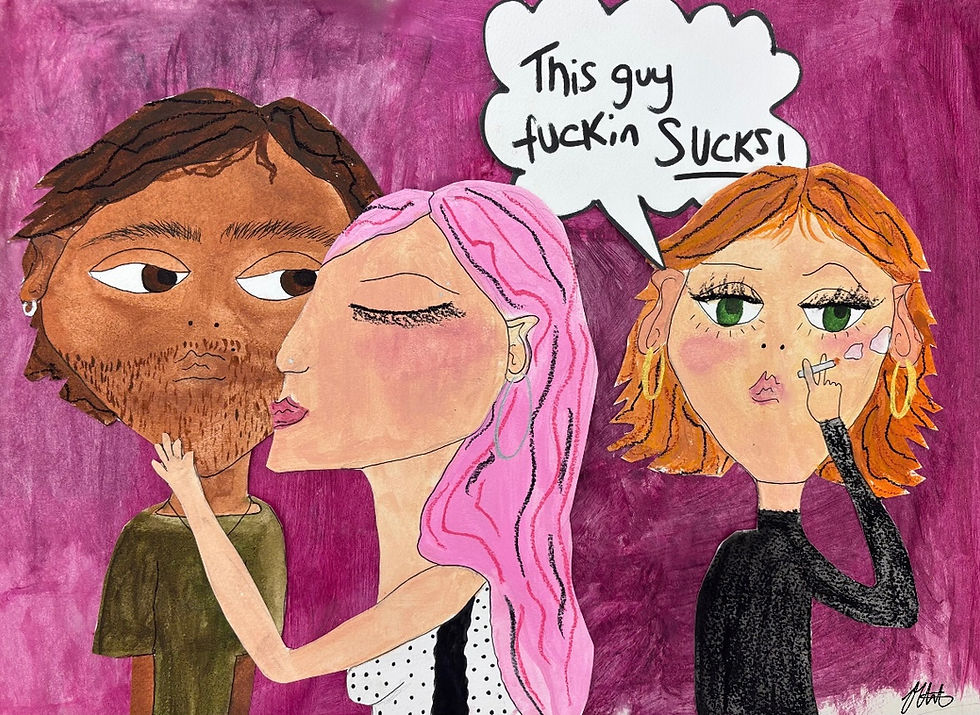
I may be wrong, but I feel fairly confident that when you read the title of this article, at least one man came to mind. Maybe more. That alone feels like a small cultural emergency. How is it that women with such a lust for life, so much joy, humour, and potential, keep ending up with the most deeply uninteresting men alive? I have watched it happen to friend after friend, each time different, and yet somehow exactly the same. And to be clear, I am not writing this from a place of moral superiority; I have been with plenty of losers. This is not about bitching for sport or tearing men down for fun. It is about naming something that keeps happening, over and over again, to women who deserve far more than the relationships they are settling into. This is the loser boyfriend epidemic.
I have hated my friends’ boyfriends, not because they were scary or cruel or obviously evil, but because of how they affected some of the best women I’ve ever known. They were the people who lit up a room. Around these men, they dimmed. I watched it happen in real time, again and again. Conversations shortened, insecurities grew, communication shrank. The versions of them I knew best only really reappeared when their boyfriends were not there. In a small survey I conducted, the overwhelming majority of respondents said they felt their friend’s boyfriend had dimmed her sparkle. That word kept coming up. Sparkle. Not confidence or ambition or independence, but something more fragile and harder to name. Something that disappeared quietly, until one day you realised it was gone.
Part of the reason the loser boyfriend thrives is because we have collectively agreed to applaud men for doing almost nothing. The bar is not low, it is subterranean. A man remembers your birthday, and suddenly, he is a god. He buys you your least favourite flowers once, after a massive argument, and you cry tears of joy. He posts you on Instagram, after you begged him to, and people comment hearts as if he has proposed. Meanwhile, our friends could recite our Off Menu order, name our Spotify Wrapped top songs, and know how our voice sounds when we’re on the verge of tears. They make us handmade gifts, show up unprompted, listen properly, and remember everything. None of this is considered remarkable. It is just expected. A loser’s best is a thoughtful friend’s worst, yet we are still expected to swoon when a man listens to three things we say in a day and calls it effort.
Years ago, my mum told me that criticising your friends’ boyfriends is a dangerous game, and it stuck with me. For many women, a relationship is not just a partnership but a reflection of the self. So when you criticise the boyfriend, it does not feel like concern, it feels like a personal attack. This is why conversations so often collapse into “you don’t know him like I do” or frantic attempts to list two or three kind gestures in a sea of consistently shit behaviour. The relationship becomes something to defend at all costs, even when it is clearly causing harm. In the survey I conducted, the majority of respondents said their friends either shut down, changed the subject, or became angry or tearful when criticism was raised. The reaction is rarely about the man himself; it is about protecting a fragile self-reflection that feels under threat.
Admitting that you have allowed yourself to be treated poorly is deeply humiliating. It is often easier to defend the man who is hurting you than to face the reality that you stayed, justified, and compromised yourself for him. I know this because I have done it. Looking back on my own past relationship, I am forced to confront how much I excused, how small I made myself, and how fiercely I protected a man who did not deserve it. Accepting that version of yourself requires an uncomfortable level of honesty. It means sitting with shame rather than deflecting it. Defensiveness, then, becomes less about love and more about self-preservation. Sometimes the hardest part of leaving a loser boyfriend is not losing him, but admitting how long you let him stay.
The damage does not stop at the relationship itself. It spills outward and begins to rot friendships, social lives, and entire group dynamics. You reach a point where you know that at every group event, he will be there. Not because anyone invited him directly, but because she no longer goes anywhere without him. You are not choosing to avoid your friend. You are choosing to avoid the man attached to her.
Many respondents described being forced into social settings with men they actively disliked, with no real choice in the matter. One respondent described going to raves as a trio, only for the boyfriend to spend the entire night clamped to her friend from behind, deciding when they arrived and when they left. He did not dance, speak, or socialise. He simply hovered, pulling his girlfriend away early and even leaving the friend alone and unsafe. What should have been joyful and communal became claustrophobic. It was not protective. It was control. Over time, resentment builds quietly. You are no longer just watching your friend settle. You are being asked to tolerate it.
Eventually, staying starts to hurt more than leaving. Repeating the same concern, softening it, rephrasing it, and watching it be dismissed again and again is quietly exhausting. It is heart-breaking to love someone and feel powerless as they make the same choice over and over, especially when that choice is costing them friendships, joy, and parts of themselves. Loyalty begins to clash with self-respect. Constant proximity breeds resentment, and resentment breeds silence. The survey sadly showed that many respondents described seeing friends less and less, sometimes reduced to once every six months, not because love had disappeared but because closeness had become too painful to maintain. One respondent spoke about the end of a nine-year friendship, worn down not by one argument but by years of accumulated resentment. Stepping back in these moments is often framed as cruelty or abandonment, but more often it is an act of self-preservation. Sometimes distance is the only way to protect your own emotional well-being while still holding love for the person you cannot reach.
Control rarely looks like control when you are inside it. More often, it disguises itself as concern and boundaries. Several respondents described boyfriends who were older, more established, and quietly authoritative, men who positioned themselves as knowing better. This often came with isolation. Friends were framed as bad influences. Hobbies became inconvenient. Nights out slowly disappeared. I often think about an old friend of mine whose boyfriend banned her from watching Sex Education and Love Island because he deemed them pornographic. This is despite the fact that Sex Education is possibly the least sexy show ever made. At the time, it sounded ridiculous. In hindsight, it was not funny at all. It was about control over what she consumed, what she enjoyed, and what ideas she was allowed to engage with. Survey responses echoed this pattern again and again: jealousy disguised as protection, fun reframed as irresponsibility, and independence slowly chipped away until staying home felt easier than arguing.
I am not saying every unremarkable man requires an emergency group chat. But if his strongest selling point is that he is “not that bad,” the bar is functionally meaningless. We are allowed to want more for the people we love. We are allowed to be exhausted by watching brilliant women bend logic, standards, and themselves to justify men who bring nothing to the table.
None of this is written with hatred for the women who stay; if anything, it is written because of how deeply they are loved. The loser boyfriend epidemic persists not because women are foolish or weak, but because we have built a culture where men are rewarded for trying, and women are expected to survive it. Naming this pattern is uncomfortable, especially when it forces us to look at our own past choices or the friendships we have lost along the way. But silence has never protected anyone. If this article feels confronting, good. Recognition is supposed to sting a little. We do not hate these men because it is fun, though frankly, it can be. We hate them because we have watched too many extraordinary women shrink themselves to fit into mediocre relationships, and we are done pretending that love is supposed to feel like settling. It is not. It never was.
Words and artwork by Ottilie Trevor-Harris, she/her
Comments